Malaysia, 23 January 2026 — The academic environment at the Faculty of Islamic Studies, Universiti Kebangsaan Malaysia (UKM), was marked by strong intellectual engagement on Thursday (23/1) during a Scopus Journal Writing Workshop focusing on Substantive Review Standards for International Publications. The session featured Badrun Taman, Editor in Chief of Jurnal Ilmiah Mizani and Editor at Islamic Research Publisher, as the main speaker.

Conducted from 8:00 a.m. to 11:00 a.m. (local time), the workshop brought together lecturers, researchers, and postgraduate students aiming to elevate their manuscripts to meet Scopus-indexed journal standards, particularly in the field of contextualized Islamic law. The program was designed not merely as a technical writing session, but as a conceptual and methodological realignment toward global academic expectations.
Although held online, the training was highly interactive and intellectually intensive. Participants actively engaged through critical questions and manuscript-based discussions, creating a scholarly atmosphere comparable to an in-person academic forum. The dynamic exchange demonstrated that rigorous academic dialogue transcends physical boundaries.
In his presentation, Badrun Taman provided an in-depth explanation of substantive review, a core evaluative process used by Scopus reviewers to assess manuscript eligibility. He emphasized that substantive review focuses on depth of analysis, logical coherence, methodological rigor, clarity of research gaps, and the significance of scholarly contributions, rather than surface-level language or formatting issues.
Drawing from his editorial experience at Islamic Research Publisher and as Editor in Chief of Jurnal Ilmiah Mizani, he systematically guided participants through best practices for each section of a Scopus-standard article—ranging from title formulation and structured abstracts to the critical roles of introduction, methods, discussion, and references. Particular attention was given to common causes of major revisions and rejections, especially weak research gaps, unclear methodologies, and underdeveloped discussions.
He stressed that successful international publication requires more than proficiency in academic English. Instead, it demands strong theoretical grounding, transparent and replicable methodology, analytical depth, and strict adherence to global publication ethics. According to him, most articles accepted by reputable journals pass through major revisions, making resilience and responsiveness to reviewer feedback essential academic skills.
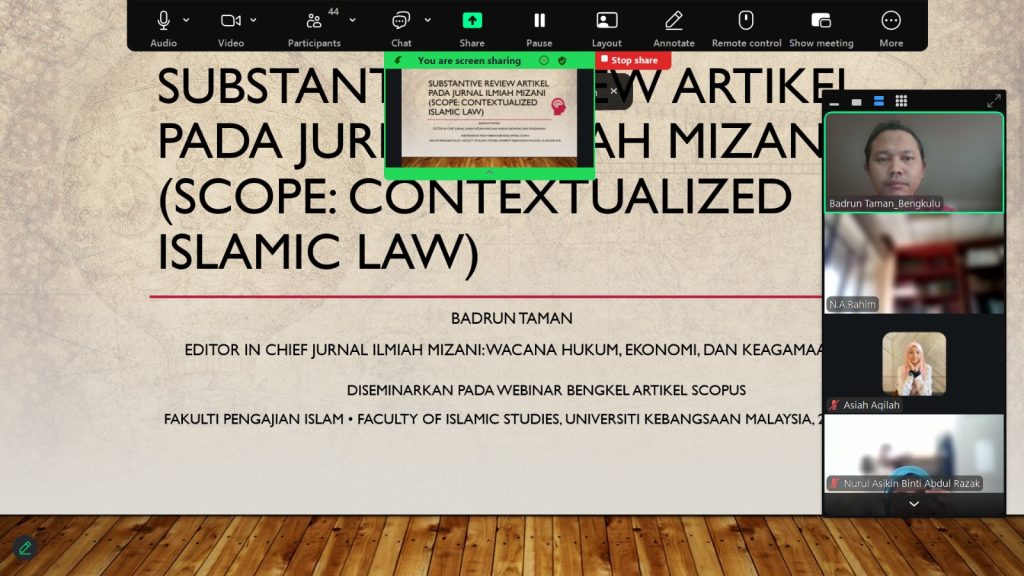
Badrun Taman’s contribution to this workshop reflects the growing role of cross-border editorial collaboration in strengthening the quality of Islamic legal scholarship. The Faculty of Islamic Studies UKM views this training as part of its broader commitment to fostering internationally competitive research and expanding its scholars’ presence in global academic discourse.
The workshop concluded with a reaffirmation of a key message: international publication is no longer optional—it is an academic imperative in today’s globalized research environment.